Functional Electrical Stimulation (FES) Specialty Center

At The Recovery Project, we’re continually looking to implement the latest evidence-based treatment approaches to help our patients maximize their neurological recovery and overall health — and the FES Specialty Center at TRP helps do just that.
Functional electrical stimulation (FES) treatment techniques help aid in motor recovery from many central nervous system disorders by using highly specialized equipment to administer pulses of electrical current to patients through adhesive pads. This evokes coordinated muscle contractions that imitate muscle functionality and gives patients the health-related benefits of exercise.

FES helps children and adults living with:

FES has been proven to deliver a variety of health benefits, including:

The Recovery Project is one of the few clinics in Michigan to have a dedicated FES Specialty Center, which offers patients access to state of the art FES equipment, including:

RT300-SLSA Leg and Arm Cycle

With the RT300-SLSA, patients can perform arm and leg exercises directly from a wheelchair without transferring to or using a chair, plinth, or balance ball. When used for arm cycling, FES can be applied to the patient’s biceps, triceps, anterior deltoid, posterior deltoid, grasp, or wrist extensors/release muscles. For leg cycling, FES can be applied to the quadriceps, hamstrings, glutes, gastrocs, and anterior tibials. For core strength and stability, FES can be applied to the abdominal and back muscle groups.

RT600 Stepper

The RT600 is a fully integrated, upright FES stepping system that allows patients to bear their own weight during use. FES can be applied to the quadriceps, hamstrings, gluteals, gastrocs, anterior tibials, abdominals, and shoulder and scap stabilization muscles.

Xcite

The Xcite is a portable multi-channel FES stimulator that allows patients to work on meaningful ADLs and movements including feeding, scooting transfers, sits/stands, and step-ups.

Rehab Moves 2

This is a mobile FES device used with the Motomed UE and LE cycle, or on a mat. The device has a total of four channels that can be coordinated during individually designed functional activities.

VitalStim for Dysphagia and Dysarthria

An FES unit that is used to retrain the muscles needed to complete the swallowing process through specially designed electrodes that are attached to the patient’s neck. A small current stimulates motor nerves, causing the muscles in the neck to contract for improved swallowing.

TSS1 min

Transcutaneous Spinal Cord Stimulation (TSCS)
also called Transpinal Stimulation or TSS

The disruption of transmission of motor and sensory information is associated with spinal cord injury that significantly impacts a person's ability to purposely move. Nearly 70% of new injuries each year are incomplete with incomplete tetraplegia as the fastest growing injury classification. Many of these patients will present with motor dysfunction. Recovery of hand and walking functions are a high priority among individuals with incomplete spinal cord injury.

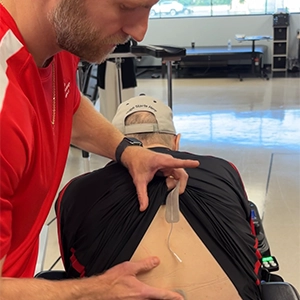
TSS is a non-invasive treatment using surface electrodes to modulate spinal cord activity. Neural structures within the spinal cord are not directly electrically stimulated, but transynpatically activated by the posterior root-stimulation with TSS. This improves the information going to the brain which in return allows people to optimize this information to improve function.

TSS is best used in combination with high intensity interventions (therapy), where CNS excitation is perpetuated. TSS is a promising tool to augment the patients work being done in therapeutic setting with the potential to expedite recovery.

What to Expect

Patients will often report immediate changes in sensation, mostly deep touch and proprioception and a latent impact on tone. Other improvements noted include improved trunk control, gait quality, improvements in endurance/exercise tolerance and even bladder/bowel sensation. These responses will be monitored in and out of therapy at TRP to determine optimal dosage and overall effectiveness.

TSS has been strongly studied in the SCI population, but evidence is growing in the CVA and MS populations. Early studies indicate TSS can help with postural stability, spasticity and gait in the CVA and MS populations. The research is ongoing but early results suggest that it could become a valuable tool that is consistently used in the field of neurorehabilitation. Its non-invasive nature, potential for broad accessibility, and integration with existing therapy make it an exciting innovation that is transforming neurorehabilitation.